PGMPy Datasets API
A guided exploration of pgmpy’s dataset loading subsystem:
list_datasets(): Discover available datasets with rich filtersload_dataset(): Load a dataset by name into a structuredDatasetobjectDatasetattributes: tabular data, ground-truth DAG, expert knowledge, metadata tags
This module is the entry point for obtaining benchmark data used in causal discovery, structure learning, and parameter estimation.
Imports and Setup
%load_ext autoreload
%autoreload 2

import logging
import warnings

warnings.filterwarnings("ignore")
The autoreload extension is already loaded. To reload it, use:
%reload_ext autoreload
import pgmpy.datasets as ds
import pandas as pd
# Use this for most notebooks.
import helpers.htutorial as htutori
htutori.config_notebook()
# Import pgmpy utilities.
import tutorials.pgmpy.pgmpy_utils as tpgpguti
# Initialize logger.
logging.basicConfig(level=logging.INFO)
_LOG = logging.getLogger(__name__)
# Convert `display` into `print()` when running outside IPython.
try:
from IPython.display import display
except ImportError:
display = print # type: ignoreINFO:helpers.htutorial:Setting notebook style
INFO:helpers.htutorial:Notebook signature
INFO:helpers.htutorial:numpy version=2.4.6
WARNING:helpers.htutorial:pymc is not installed
INFO:helpers.htutorial:matplotlib version=3.10.9
WARNING:helpers.htutorial:arviz is not installed
WARNING:helpers.htutorial:preliz is not installed
WARNING:helpers.htutorial:sns is not installed
Python 3.12.13
Linux 6cd63cc7886d 6.12.67-linuxkit #1 SMP Sun Jan 25 02:26:28 UTC 2026 aarch64 GNU/Linux
import logging

logging.getLogger("httpx").setLevel(logging.WARNING)
Part 1: Library Overview
What problem does pgmpy.datasets solve?
- Provides one-line access to 47+ curated benchmark datasets for graphical models
- Eliminates the boilerplate of finding, downloading, and parsing standard datasets
- Some datasets include the true causal graph (ground truth) for supervised evaluation
- Some include expert domain knowledge (edge constraints) for causal discovery
Key abstractions
- Catalog:
list_datasets()returns a list of dataset name strings- Supports keyword filters:
is_discrete,is_continuous,has_ground_truth, etc.
- Supports keyword filters:
- Loader:
load_dataset(name)returns a singleDatasetobject - Dataset: A lightweight dataclass with five key fields:
name(str): Dataset identifierdata(pd.DataFrame): The actual tabular dataground_truth(DAG or None): True causal graph (when available)expert_knowledge(ExpertKnowledge or None): Domain edge constraintstags(dict): Metadata (n_variables, n_samples, data types, etc.)
How the pieces fit together
User -> list_datasets(is_discrete=True) -> ['college_plans', ...]
User -> load_dataset('sachs_discrete')
     -> Dataset(name='sachs_discrete',
                data=DataFrame(5400 x 11),
                ground_truth=DAG(11 nodes, 20 edges),
                tags={n_variables: 11, ...})
Part 2: Primitive-by-Primitive Exploration
Primitive 1: list_datasets(): The Catalog
Mental model: A searchable registry of all available benchmark datasets.
Returns a plain list of name strings suitable for passing to load_dataset().
# Smallest construction: no arguments returns all 47+ datasets.
all_datasets = ds.list_datasets()
print(f"Total datasets available: {len(all_datasets)}")
print("\n".join(all_datasets))
Total datasets available: 47
abalone_continuous
abalone_mixed
adult
airfoil
algerian_forest
angrist_krueger_qob
apple_watch_fitbit
auto_mpg
blue_driver
boston_housing
cities
college_plans
contraceptive_method
cover_type
credit_approval
cystic_fibrosis
depression_coping
dropouts
dry_bean
galton_stature
goldberg
hitters
htru2
hungary_chickenpox
iq_brain_size
lead
myocardial_infarction
pima_diabetes
pittsburgh_bridges
residential_building
sachs_continuous
sachs_continuous_jittered
sachs_continuous_jittered_logscale
sachs_continuous_logscale
sachs_discrete
sachs_mixed
seoul_bike
south_german_credit
spartina
student_performance
superconductivity
tubingen
uscrime
wine_quality_red
wine_quality_red_white_mixed
wine_quality_white
yacht_hydrodynamics
# Filter by data type: discrete only.
discrete_ds = ds.list_datasets(is_discrete=True)
print(f"Discrete datasets ({len(discrete_ds)}): {discrete_ds}")
Discrete datasets (3): ['college_plans', 'pittsburgh_bridges', 'sachs_discrete']
# Filter by data type: continuous only.
continuous_ds = ds.list_datasets(is_continuous=True)
print(f"Continuous datasets ({len(continuous_ds)}): {continuous_ds[:10]}")
Continuous datasets (23): ['abalone_continuous', 'airfoil', 'angrist_krueger_qob', 'blue_driver', 'boston_housing', 'cities', 'depression_coping', 'dropouts', 'goldberg', 'hungary_chickenpox']
# Filter by data type: mixed (both discrete and continuous columns).
mixed_ds = ds.list_datasets(is_mixed=True)
print(f"Mixed datasets ({len(mixed_ds)}): {mixed_ds}")
Mixed datasets (22): ['abalone_mixed', 'adult', 'algerian_forest', 'apple_watch_fitbit', 'auto_mpg', 'contraceptive_method', 'cover_type', 'credit_approval', 'cystic_fibrosis', 'dry_bean', 'galton_stature', 'hitters', 'htru2', 'pima_diabetes', 'residential_building', 'sachs_mixed', 'seoul_bike', 'south_german_credit', 'student_performance', 'tubingen', 'uscrime', 'wine_quality_red_white_mixed']
# Filter by presence of ground truth.
with_gt = ds.list_datasets(has_ground_truth=True)
print(f"Datasets with ground truth ({len(with_gt)}): {with_gt}")
Datasets with ground truth (8): ['hungary_chickenpox', 'sachs_continuous', 'sachs_continuous_jittered', 'sachs_continuous_jittered_logscale', 'sachs_continuous_logscale', 'sachs_discrete', 'sachs_mixed', 'tubingen']
# Filter by number of variables.
few_vars = ds.list_datasets(n_variables=5)
print(f"Datasets with exactly 5 variables: {few_vars}")

ten_vars = ds.list_datasets(n_variables=10)
print(f"Datasets with exactly 10 variables: {ten_vars}")
Datasets with exactly 5 variables: ['angrist_krueger_qob', 'college_plans', 'galton_stature']
Datasets with exactly 10 variables: ['blue_driver']
# Combine multiple filters for precise selection.
rare = ds.list_datasets(is_interventional=True)
print(f"Interventional datasets ({len(rare)}): {rare}")

simulated = ds.list_datasets(is_simulated=True)
print(f"Simulated datasets ({len(simulated)}): {simulated}")
Interventional datasets (3): ['sachs_continuous_jittered', 'sachs_continuous_jittered_logscale', 'sachs_mixed']
Simulated datasets (4): ['dropouts', 'goldberg', 'lead', 'spartina']
Primitive 2: load_dataset(): The Loader
Mental model: Given a name string from the catalog, load and return a fully
populated Dataset object with tabular data and optional metadata.
# Smallest construction: load a simple dataset.
data = ds.load_dataset("galton_stature")
print(f"Loaded dataset: {data.name}")
print(f"Object type: {type(data)}")
Loaded dataset: galton_stature
Object type: <class 'pgmpy.datasets._base.Dataset'>
# Inspect the object.
print(f"type(data): {type(data)}")
print(
    "dir(data) basic attributes:",
    [a for a in dir(data) if not a.startswith("_")],
)
type(data): <class 'pgmpy.datasets._base.Dataset'>
dir(data) basic attributes: ['data', 'expert_knowledge', 'ground_truth', 'name', 'tags']
# Try loading a different dataset.
data2 = ds.load_dataset("pima_diabetes")
print(f"Loaded: {data2.name}")
print(f"type: {type(data2)}")
print(f"dir: {[a for a in dir(data2) if not a.startswith('_')]}")
Loaded: pima_diabetes
type: <class 'pgmpy.datasets._base.Dataset'>
dir: ['data', 'expert_knowledge', 'ground_truth', 'name', 'tags']
Primitive 3: Dataset.data: The Tabular Data
Mental model: The actual observations as a pandas DataFrame, ready for
estimator.fit(data).
# Load the Pima diabetes dataset.
data = ds.load_dataset("pima_diabetes")

# Inspect the data field.
print(f"type: {type(data.data)}")
print(f"shape: {data.data.shape}")
print(f"columns: {list(data.data.columns)}")
print(f"dtypes:\n{data.data.dtypes}")
print("\nfirst 5 rows:")
display(data.data.head())
type: <class 'pandas.DataFrame'>
shape: (768, 9)
columns: ['Pregnancies', 'Glucose', 'BloodPressure', 'SkinThickness', 'Insulin', 'BMI', 'DiabetesPedigreeFunction', 'Age', 'Outcome']
dtypes:
Pregnancies int64
Glucose int64
BloodPressure int64
SkinThickness int64
Insulin int64
BMI float64
DiabetesPedigreeFunction float64
Age int64
Outcome category
dtype: object
first 5 rows:
# Check basic statistics.
print(f"Missing values: {data.data.isnull().sum().sum()}")
print("Summary statistics:")
display(data.data.describe())
Missing values: 0
Summary statistics:
Primitive 4: Dataset.ground_truth: The True Causal Graph
Mental model: When available, this is a DAG object representing the true
underlying causal structure. Used to evaluate how well a causal discovery
algorithm recovered the correct graph.
# Load a dataset with ground truth.
data = ds.load_dataset("sachs_discrete")

# Inspect the ground truth.
print(f"ground_truth type: {type(data.ground_truth)}")
print(f"Number of nodes: {len(data.ground_truth.nodes())}")
print(f"Number of edges: {len(data.ground_truth.edges())}")
print(f"\nNodes: {sorted(list(data.ground_truth.nodes()))}")
print(f"\nEdges: {list(data.ground_truth.edges())}")
ground_truth type: <class 'pgmpy.base.DAG.DAG'>
Number of nodes: 11
Number of edges: 20
Nodes: ['akt', 'erk', 'jnk', 'mek', 'p38', 'pip2', 'pip3', 'pka', 'pkc', 'plc', 'raf']
Edges: [('erk', 'akt'), ('mek', 'erk'), ('pip2', 'pkc'), ('pkc', 'jnk'), ('pkc', 'mek'), ('pkc', 'p38'), ('pkc', 'pka'), ('pkc', 'raf'), ('pip3', 'akt'), ('pip3', 'pip2'), ('pip3', 'plc'), ('plc', 'pip2'), ('plc', 'pkc'), ('pka', 'akt'), ('pka', 'erk'), ('pka', 'jnk'), ('pka', 'mek'), ('pka', 'p38'), ('pka', 'raf'), ('raf', 'mek')]
_ = tpgpguti.draw_pgmpy_model(data.ground_truth)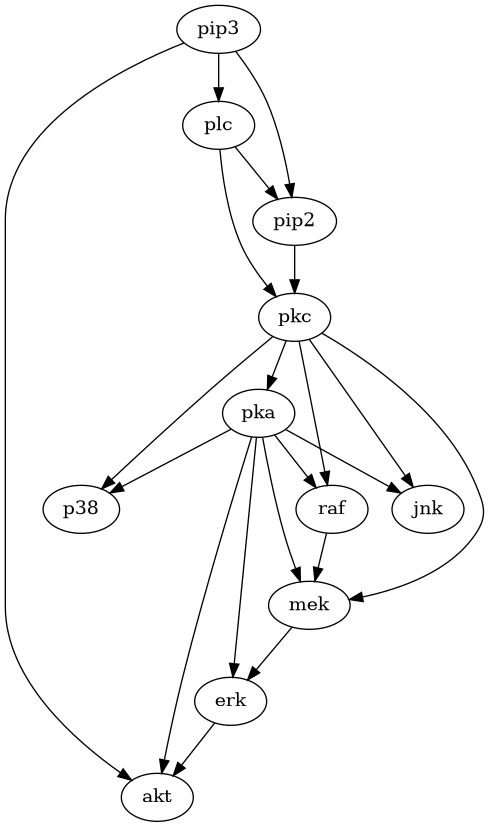
# Inspect the DAG: check predecessors and successors.
gt = data.ground_truth
print(f"Predecessors of 'erk': {list(gt.predecessors('erk'))}")
print(f"Successors of 'pkc': {list(gt.successors('pkc'))}")
print(f"Is 'pkc' a parent of 'jnk'?: {gt.has_edge('pkc', 'jnk')}")
print(f"Is 'jnk' a parent of 'pkc'?: {gt.has_edge('jnk', 'pkc')}")
Predecessors of 'erk': ['mek', 'pka']
Successors of 'pkc': ['jnk', 'mek', 'p38', 'pka', 'raf']
Is 'pkc' a parent of 'jnk'?: True
Is 'jnk' a parent of 'pkc'?: False
# Check what happens when a dataset has no ground truth.
data2 = ds.load_dataset("galton_stature")
print(f"galton_stature ground_truth: {data2.ground_truth}")
# Returns None : the field is optional.
galton_stature ground_truth: None
Primitive 5: Dataset.expert_knowledge: Domain Constraints
Mental model: Prior knowledge about edges that must be present, must be absent, or temporal ordering, which is used to guide causal discovery algorithms.
# Load a dataset with expert knowledge.
data = ds.load_dataset("sachs_discrete")

# Inspect expert knowledge.
ek = data.expert_knowledge
print(f"expert_knowledge type: {type(ek)}")
print(f"forbidden_edges: {ek.forbidden_edges}")
print(f"required_edges count: {len(ek.required_edges)}")
print(f"required_edges (sample): {list(ek.required_edges)[:5]}")
print(f"search_space: {ek.search_space}")
print(f"temporal_order: {ek.temporal_order}")
expert_knowledge type: <class 'pgmpy.causal_discovery.ExpertKnowledge.ExpertKnowledge'>
forbidden_edges: set()
required_edges count: 20
required_edges (sample): [('pkc', 'pka'), ('plc', 'pkc'), ('mek', 'erk'), ('pkc', 'jnk'), ('pkc', 'p38')]
search_space: set()
temporal_order: [[], [], []]
# Check dataset without expert knowledge.
data2 = ds.load_dataset("galton_stature")
print(f"galton_stature expert_knowledge: {data2.expert_knowledge}")
galton_stature expert_knowledge: None
Primitive 6: Dataset.tags: Metadata Dictionary
Mental model: A dictionary of descriptive metadata about the dataset, including counts, boolean flags for data type, and provenance info.
# Load a dataset and inspect tags.
data = ds.load_dataset("sachs_discrete")
print(f"tags type: {type(data.tags)}")

# Print each tag key-value pair.
for key, value in data.tags.items():
    print(f"  {key}: {value}")
tags type: <class 'dict'>
name: sachs_discrete
n_variables: 11
n_samples: 5400
has_ground_truth: True
has_expert_knowledge: True
has_missing_data: False
has_index_col: False
is_simulated: False
is_interventional: False
is_discrete: True
is_continuous: False
is_mixed: False
is_ordinal: False
# Compare tags across different dataset types.
sachs_tags = ds.load_dataset("sachs_discrete").tags
galton_tags = ds.load_dataset("galton_stature").tags

# Build a comparison DataFrame from the tags dictionaries.
tags_df = pd.DataFrame(
    {
        "Property": list(sachs_tags.keys()),
        "sachs_discrete": [str(sachs_tags[k]) for k in sachs_tags],
        "galton_stature": [str(galton_tags[k]) for k in sachs_tags],
    }
)
display(tags_df)
Part 3: Composition Examples
Example 1: List a Category, Load the First Dataset, Inspect It
Minimal workflow: discover -> load -> explore.
# Discover discrete datasets.
discrete = ds.list_datasets(is_discrete=True)
print(f"Discrete datasets: {discrete}")

# Load the first one.
ds1 = ds.load_dataset(discrete[0])
print(f"\nName: {ds1.name}")
print(f"Shape: {ds1.data.shape}")
print(f"Columns: {list(ds1.data.columns)}")
display(ds1.data.head())

# Print tags.
for k, v in ds1.tags.items():
    print(f"  {k}: {v}")
Discrete datasets: ['college_plans', 'pittsburgh_bridges', 'sachs_discrete']
Name: college_plans
Shape: (10318, 5)
Columns: ['sex', 'iq', 'cp', 'pe', 'ses']
  name: college_plans
  n_variables: 5
  n_samples: 10318
  has_ground_truth: False
  has_expert_knowledge: False
  has_missing_data: False
  has_index_col: False
  is_simulated: False
  is_interventional: False
  is_discrete: True
  is_continuous: False
  is_mixed: False
  is_ordinal: True
Example 2: Filter by Ground Truth, Load, Compare Data vs Graph
gt_ds = ds.list_datasets(has_ground_truth=True)
print(f"Datasets with ground truth: {gt_ds}")

# Use `sachs_discrete` since some ground-truth graphs have parsing issues.
ds2 = ds.load_dataset("sachs_discrete")

print(f"Dataset: {ds2.name}")
print(f"Data shape: {ds2.data.shape}")
print(f"Ground truth nodes: {len(ds2.ground_truth.nodes())}")
print(f"Ground truth edges: {len(ds2.ground_truth.edges())}")

# Show a few rows.
display(ds2.data.head(3))

# Show the graph edges.
print(f"Edges: {list(ds2.ground_truth.edges())}")
Datasets with ground truth: ['hungary_chickenpox', 'sachs_continuous', 'sachs_continuous_jittered', 'sachs_continuous_jittered_logscale', 'sachs_continuous_logscale', 'sachs_discrete', 'sachs_mixed', 'tubingen']
Dataset: sachs_discrete
Data shape: (5400, 11)
Ground truth nodes: 11
Ground truth edges: 20
Edges: [('erk', 'akt'), ('mek', 'erk'), ('pip2', 'pkc'), ('pkc', 'jnk'), ('pkc', 'mek'), ('pkc', 'p38'), ('pkc', 'pka'), ('pkc', 'raf'), ('pip3', 'akt'), ('pip3', 'pip2'), ('pip3', 'plc'), ('plc', 'pip2'), ('plc', 'pkc'), ('pka', 'akt'), ('pka', 'erk'), ('pka', 'jnk'), ('pka', 'mek'), ('pka', 'p38'), ('pka', 'raf'), ('raf', 'mek')]
Example 3: Load a Large Continuous Dataset and Summarize
# Find continuous datasets.
cont = ds.list_datasets(is_continuous=True)
print(f"Continuous datasets: {len(cont)}")
print(f"  {cont}")

# Load a modest-sized one.
ds3 = ds.load_dataset("airfoil")
print(f"\nDataset: {ds3.name}")
print(f"Shape: {ds3.data.shape}")
print(f"Columns: {list(ds3.data.columns)}")
display(ds3.data.describe())
Continuous datasets: 23
['abalone_continuous', 'airfoil', 'angrist_krueger_qob', 'blue_driver', 'boston_housing', 'cities', 'depression_coping', 'dropouts', 'goldberg', 'hungary_chickenpox', 'iq_brain_size', 'lead', 'myocardial_infarction', 'sachs_continuous', 'sachs_continuous_jittered', 'sachs_continuous_jittered_logscale', 'sachs_continuous_logscale', 'spartina', 'superconductivity', 'tubingen', 'wine_quality_red', 'wine_quality_white', 'yacht_hydrodynamics']
Dataset: airfoil
Shape: (1503, 6)
Columns: ['Frequency', 'Attack', 'Chord', 'Velocity', 'Displacement', 'Pressure']
Example 4: Use Expert Knowledge + Ground Truth Together
The Sachs dataset family includes both ground truth and expert knowledge, making it useful for benchmarking causal discovery algorithms.
# Load the mixed-type Sachs dataset.
ds4 = ds.load_dataset("sachs_mixed")

print(f"Dataset: {ds4.name}")
print("Data type: discrete, continuous, or mixed?")
print(f"  is_discrete: {ds4.tags['is_discrete']}")
print(f"  is_continuous: {ds4.tags['is_continuous']}")
print(f"  is_mixed: {ds4.tags['is_mixed']}")
print(f"\nShape: {ds4.data.shape}")

# Check ground truth structure.
gt = ds4.ground_truth
print(f"\nGround truth: {gt.nodes()} -> {gt.edges()}")

# Check expert knowledge.
ek = ds4.expert_knowledge
print("\nExpert knowledge:")
print(f"  Required edges: {len(ek.required_edges)}")
print(f"  Forbidden edges: {len(ek.forbidden_edges)}")
Dataset: sachs_mixed
Data type: discrete, continuous, or mixed?
is_discrete: False
is_continuous: False
is_mixed: True
Shape: (7466, 20)
Ground truth: ['erk', 'akt', 'mek', 'pip2', 'pkc', 'pip3', 'plc', 'pka', 'jnk', 'p38', 'raf'] -> [('erk', 'akt'), ('mek', 'erk'), ('pip2', 'pkc'), ('pkc', 'jnk'), ('pkc', 'mek'), ('pkc', 'p38'), ('pkc', 'pka'), ('pkc', 'raf'), ('pip3', 'akt'), ('pip3', 'pip2'), ('pip3', 'plc'), ('plc', 'pip2'), ('plc', 'pkc'), ('pka', 'akt'), ('pka', 'erk'), ('pka', 'jnk'), ('pka', 'mek'), ('pka', 'p38'), ('pka', 'raf'), ('raf', 'mek')]
Expert knowledge:
Required edges: 20
Forbidden edges: 0
# Check that the same ground truth graph is shared across all Sachs variants.
sachs_variants = [n for n in ds.list_datasets() if n.startswith("sachs")]
print(f"Sachs variants: {sachs_variants}")

gt_edges = {}
for name in sachs_variants:
    try:
        d = ds.load_dataset(name)
        gt_edges[name] = len(d.ground_truth.edges())
        print(
            f"  {name}: {d.data.shape}, GT edges: {len(d.ground_truth.edges())}"
        )
    except Exception as e:
        print(f"  {name}: ERROR - {type(e).__name__}")

# All Sachs variants share the same ground truth graph.
all_same = len(set(gt_edges.values())) == 1
print(f"\nAll variants share the same graph? {all_same}")
Sachs variants: ['sachs_continuous', 'sachs_continuous_jittered', 'sachs_continuous_jittered_logscale', 'sachs_continuous_logscale', 'sachs_discrete', 'sachs_mixed']
sachs_continuous: (7466, 11), GT edges: 20
sachs_continuous_jittered: (7466, 20), GT edges: 20
sachs_continuous_jittered_logscale: (7466, 20), GT edges: 20
sachs_continuous_logscale: (7466, 11), GT edges: 20
sachs_discrete: (5400, 11), GT edges: 20
sachs_mixed: (7466, 20), GT edges: 20
All variants share the same graph? True
Part 4: API Patterns
1. Catalog-Load Pattern
The dominant pattern: list_datasets() (discover) -> load_dataset() (fetch).
This is similar to sklearn.datasets.fetch_* or PyTorch’s torchvision.datasets.
# The pattern in one line.
data = ds.load_dataset(ds.list_datasets(is_discrete=True)[0])
print(f"Loaded: {data.name}")
Loaded: college_plans
2. Filter Criterion Pattern
Filters are keyword arguments that function as predicates on the dataset metadata. Multiple filters combine with AND semantics.
# AND-combined filters: discrete AND has ground truth AND expert knowledge.
precise = ds.list_datasets(is_discrete=True, has_ground_truth=True)
print(f"Discrete datasets with ground truth: {precise}")
Discrete datasets with ground truth: ['sachs_discrete']
3. Dataset as a Dataclass
The Dataset object bundles data + metadata into one container:
data: Always present (pd.DataFrame)ground_truth: Optional (DAG or None)expert_knowledge: Optional (ExpertKnowledge or None)tags: Always present (dict)
# Show the dataclass structure via a print.
print(ds.load_dataset("boston_housing"))
Dataset(name=boston_housing,
data=DataFrame of size: (506, 14),
expert_knowledge=None,
ground_truth=None,
tags={'name': 'boston_housing', 'n_variables': 14, 'n_samples': 506, 'has_ground_truth': False, 'has_expert_knowledge': False, 'has_missing_data': False, 'has_index_col': False, 'is_simulated': False, 'is_interventional': False, 'is_discrete': False, 'is_continuous': True, 'is_mixed': False, 'is_ordinal': False})